


I’m fresh off the heels of a fabulous trip to Santa Barbara this past weekend. I tasted more wine than I care to admit and took in the gorgeous sunshine and adorable, quaint vibe of their “funk zone.” In case you missed it, I posted a little recap here. Once I posted that my mom responded via dm “rich girl behavior.” This genuinely got me thinking… why is it that wine automatically translates to luxury, and do you have to actually have money to participate? So, that’s our culture topic this week.
Also, we’re continuing to learn more about South African wine by digging into the region’s very own Santa Barbara, which has great wine - but also a somewhat dark reality. And lastly, my wine pick this week is courtesy of this past weekend’s travels. Thank you, Santa Barbara! You gave me much inspiration for this week’s newsletter.
Let’s begin.
Regional Spotlight: Six Weeks of South Africa - Constantia
We’re back in South Africa this week, and this time we are talking about the country’s hidden gem: Constantia. While last week’s Stellenbosch is known for Bordeaux style reds and prestige, Constantia is known for their award-winning Sauvignon Blanc and Vin de Constance. Let’s put it this way, if Stellenbosch is Napa, Constantia is the Santa Barbara of South Africa—cooler, coastal, elegant, and incredibly historic.
Constantia is the oldest wine region in the Southern Hemisphere. Founded in 1685, it predates almost every famous New World wine region. It’s only about 20 minutes south of Cape Town, tucked against Table Mountain and overlooking False Bay. Despite its tiny size ( and it’s very very small), it’s one of the most influential wine regions in history.
During the 1700s and early 1800s, Constantia dessert wines were arguably the most famous wines in the world. It’s recorded that Napoleon requested bottles while in exile and there is historical proof that they were poured in royal courts such as France, England, and Russia. You can even read it referenced in literature, from writers like Jane Austen and Charles Dickens.
The region is cooled by the Atlantic ocean and mountains which means growing season temperatures are much lower. This allows grapes to ripen slowly and slow ripening results in: higher acidity, more aromatics, longer hang time, and elegant alcohol levels.
You know what that means, Sauvignon Blanc thrives here. It’s their most famous grape and is truly an exceptional take on the varietal. They also grow excellent Semillon (often blended with SB), Chardonnay, Cab Sauv, and Pinot Noir. But, to me their ultimate standout is Vin de Constance. It’s luscious, yet incredibly fresh, with flavors of apricot, orange marmalade, ginger, honey, white flowers, candied citrus, spice, and the perfect level of acidity.
But, here’s the unfortunate news, Constantia has historically remained one of South Africa's most historically white-owned wine regions due to centuries of land ownership patterns dating back to the Dutch colonial era. One of the uncomfortable realities of South African wine is that while Black South Africans make up the majority of the country's population, Black ownership within the wine industry remains very small. Fewer than 2% of wine farmers are Black, and land ownership has historically been one of the biggest barriers to entry. I’m not suggesting you don’t support the region, just stating the facts. If you do want to give it a try (and I think you should), here are some producers to look out for:
Klein Constantia: The most famous, known for Vin de Constance
Groot Constantia: South Africa’s oldest winery
Buitenverwachting: Known for Sauvignon Blanc
Eagles’ Nest: A modern producer making waves in the region
I hope this doesn’t bum you out too much, it’s a bummer for me too. But, this is yet another reason to stay informed on the wine that’s in your glass and how it connects to the bigger picture of the wine industry and our world. We have done a lot, but there’s still a long way to go.
Wine in Culture: Does a Higher Price Tag Actually Mean Better Wine?
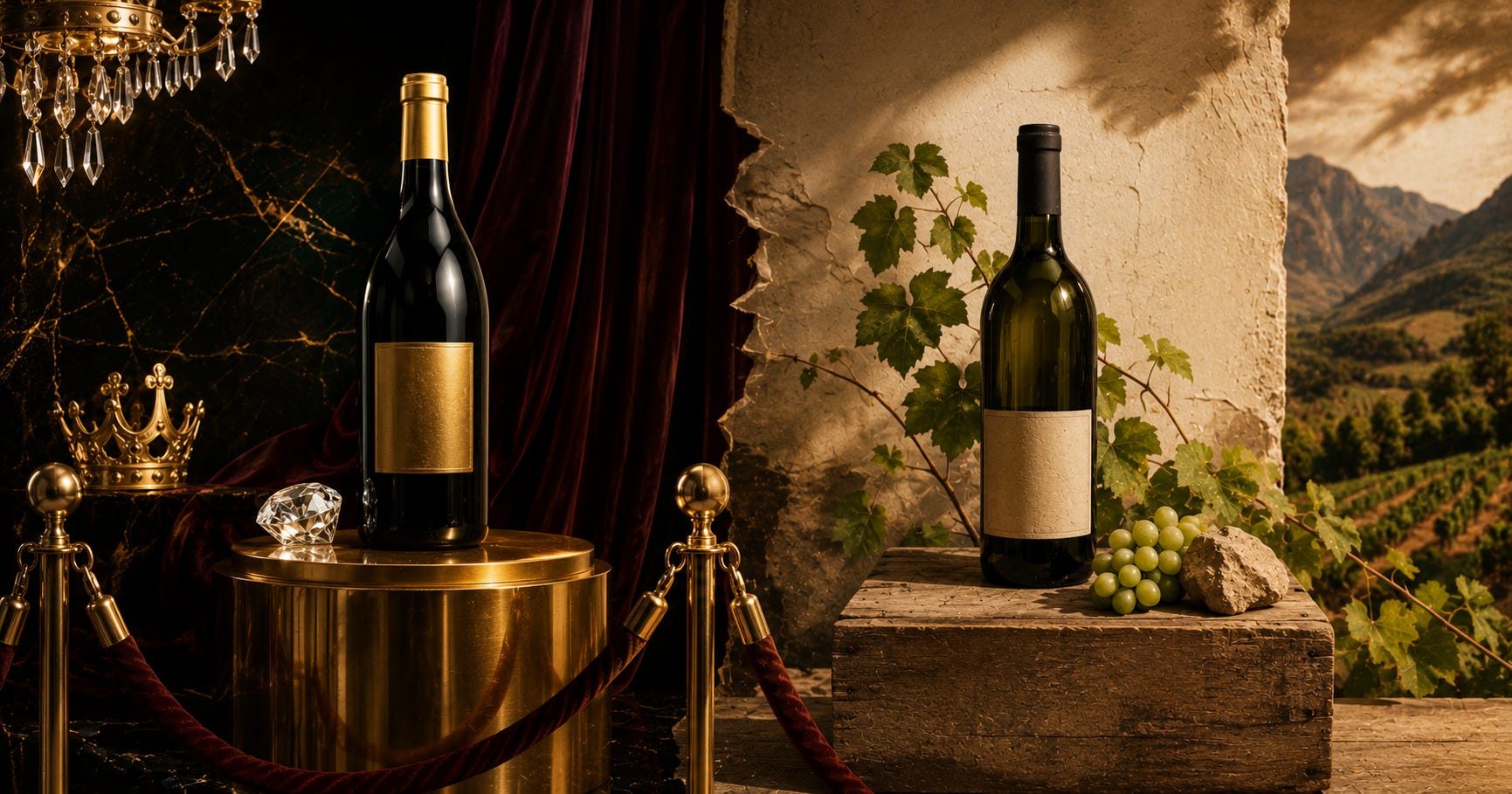
One of my favorite things about wine culture is how luxurious it can make you feel. When I lived in NYC in my shoebox apartments, I may not have had AC, a dishwasher, or in unit laundry but I always had great stemware and an excellent bottle of wine, you couldn’t tell me nothing! I would sip my wine while lounging on my ripped couch and feel like the richest woman in the world. But, why? Where does that come from? Why does wine automatically translate to wealth?
In order to understand, we have to look back. For most of history, wine was difficult to produce, transport, and preserve. Great vineyards were scarce, glass bottles were expensive, and aging wine required cellars. Kings, nobles, and wealthy merchants drank the best wines because they could afford them. That historical association never really disappeared. Unlike vodka or beer, wine is tied to a specific place. There are only so many acres of Romanée-Conti or Château Lafite. Limited supply plus global demand equals astronomical prices. Basically, it was rare and that made it valuable, and because it was valuable, it appeared superior.
But, there are more vineyards today all over the world (and more producers than anyone can count), so the “rare” argument can’t really be used anymore. But, that is where marketing steps in. Wine has always been marketed as a luxury choice, making the price feel worth it. The wine industry behaves more like Hermès than Coca-Cola. They don’t just sell you on a alcoholic beverage, they sell you on the estate, the history, the vintage, the story, the exclusivity. And, it’s working. At least it works on me. I love the story, I love knowing things about the producer, or a very important year. These are the things that makes wine special, but at what cost?
Researchers have repeatedly shown that when people are told a wine costs $90 instead of $15, they report it tastes better, even when it’s the exact same wine. Brain scans have even shown greater activity in the brain’s pleasure centers when participants believed they were drinking an expensive wine. So price doesn’t just influence purchasing, it influences taste.
When I was in my 20s and working at PBS in NYC, I had the great pleasure of meeting Jacques Pepin, the famous French chef who basically invented the omelette and renowned wine drinker. We were doing a press event for his American Masters documentary and of course he was enjoying a glass of wine. When asked about what he was drinking, he scoffed and said he had no idea, but he liked it. He’s also gone on record saying: "I rarely spend more than $10 on a bottle of wine... There's nothing wrong with drinking simple wine." But, the real question is does price really equal complexity?
When tasting a $10 bottle vs a $25 bottle, you may be able to taste a difference. This could be the result of mass production vs. small batch, think Yellow Tail or whatever we were drinking in college. But, the tricky part is when you put a $30 bottle up against a $300 bottle, you may not actually taste that much of a difference. At that point, you are actually paying for rarity, reputation, aging potential (if you care), collectible value, or brand prestige.
Paying more than you want based on things not in the actual bottle runs deep in the wine industry. In most of Europe, getting a higher price tag is built into the business model. Take France’s Burgandy for example, there are four appellations within that region. Where they are located will dictate the appellation they can put on the bottle and furthermore, what they can charge for that bottle. There’s Bourgogne AOC, Village (Gevrey-Chambertin), Premier Cru, and finally Grand Cru. A Bourgogne AOC wine can cost $15, but a Grand Cru can easily cost $500+. These are not wildly different locations, mind you. And please don’t scream at me, I know a Grand Cru vineyard isn't just a marketing label, it is literally one of the most historically exceptional pieces of vineyard land in the world, often recognized over centuries. But, when you purchase that, you have to know, you aren’t purchasing just the wine, you’re getting the history and the story with it. We see the same thing with Champagne vs. Cava or Prosecco, or even European wine vs American wine in general.
So, let’s bring this full circle: Does a higher price tag actually mean better wine? My answer: No. Wine has very good legacy marketing, but you can have the history and artful wine making at a lower cost. Wine making is a lengthy process that is part science and part art, it’s soil selection, contending with the weather (ahem, climate change) and viticulture excellence, it’s a beautiful process. I wouldn’t be studying wine if I didn’t believe that. But, I do think wine should be accessible to all, regardless of how much you make - and there’s proof that it’s possible. Here are some of the rules I live by:
I never pay more than $100 at a restaurant (if I’m footing the bill lol), look up the wine before making your selection. Most of that price is a severe mark up. I would rather bring my own and pay the cork fee.
I will pay as little as $5 for a bottle of wine, but the bottle must tell me the region it grew in. Simply saying “California” is a dead give away that it’s mass produced and probably not great, but wonderful if you plan to cook with it.
This one is hard: I never pay more than $40 for a bottle. It’s a numbers game for me, I have a lot wine I need to taste. Figure out your ceiling based on your own wine drinking habits and budget. This has changed a lot over the course of my life, it used to be $20 ceiling just a few years ago.
I’ll leave you with this, you don’t have to pay crazy money to enjoy good wine. Thanks to amazing producers all over the world, you can have complexity, the story, and the history too - while only paying $30. Here are a list of incredible producers with even better prices, save this for the next time you are at the wine shop.
Costco Kirkland Signature Series ($7–$13): Much has been said about Costco wine, and it IS mass produced, but they do work with some incredible producers to make their wine. So, don’t be afraid to give it a shot to try new varietals. Also, their holiday wine is unbeatable.
Bodegas Borsao: They have several 90+ point wines under $15
Quinta do Crasto: Red blends from Portugal that punch way above their price class, often $15–18
Produttori del Barbaresco: An Italian cooperative making shockingly good Nebbiolo; their basic Barbaresco can be found under $30 and rivals bottles 3x the price
Château de Beaucastel’s “Coudoulet de Beaucastel”: Same French winemaking team as their famous $80+ Châteauneuf-du-Pape, this bottle runs $25–30
And, this is just the tip of the iceberg, much more to come on affordable drinking!
What’s in my Glass: Margerum Grenache & Syrah


Every year, I plan a trip somewhere to drink wine for the day or the weekend. It’s affectionally called “wine weekend.” It’s a labor of love and a chance for my friends and I to make memories and discover something new and unexpected. This year, we went to Santa Barbara. I won’t talk about the region too much, I’ll save that for a future regional spotlight. But, what I will talk about is our first stop: the Margerum Tasting Room. This place set the tone for the entire day for me. Their wine was so complex and pronounced, there is no other way to say it - it felt elevated. It’s very clear that they are inspired by French (Rhone specifically) wine making, but the fact that you can actually taste in the glass is delightful. Both the Grenache and the Syrah really stood out to me. Here’s how they describe their Grenache:
This is one of our favorite wines for the table, a treasure to not be overlooked. Bright fresh, and fruity with fine soft and resolved tannins. Luscious mouthfeel with grip, savory meaty notes paired with dried flowers, spice, sweet purple fruits and jelly.
It runs $40 a bottle and is worth every penny. It was the first taste I had that made my tastebuds dance. It was also served chilled (55 degrees) which made it feel like it could be a summer red. I determined then and there that it was my wine of the day, until they brought out their Syrah that is… here’s how they describe that one:
This is the second wine from our stunning hillside estate property overlooking the Santa Ynez Valley. With steep elevations and diverse low nutrient soils this vineyard is comprised of a combination of clay loam soils and limestone outcroppings on a limestone base. The vineyard is farmed organically, ensuring an environmentally friendly approach to viticulture.
This was a game changer. It felt lush in my mouth, and I could taste every single note of black fruit and spice. It was rich on my tongue and carried a silky full body structure. I don’t think I’ve ever had a Syrah like it. It’s priced at $60 a bottle, so I won’t be getting it (see above), but you should!
wow. this was so rich and layered. it reminds me of this thing Reed used to do. he would hosts dinners at his condo for leaders. and he would serve 5 different wines throughout the night and then have everyone guess which was the most expensive. everyone always got it wrong and their favorite wine was always the lower priced one. looking forward to learning more from you on all of this 🎈
I love the walk down history lane, when you talk about the true labor of transporting rare wine and the costs associated with it. Now tell me, what about sparkling wine… that’s one where they have really really worked overtime to tell us to spend more. Is it worth it? Ace of Spades, Cristal, etc… are we really trying to take it there, or is Andre just fine?