


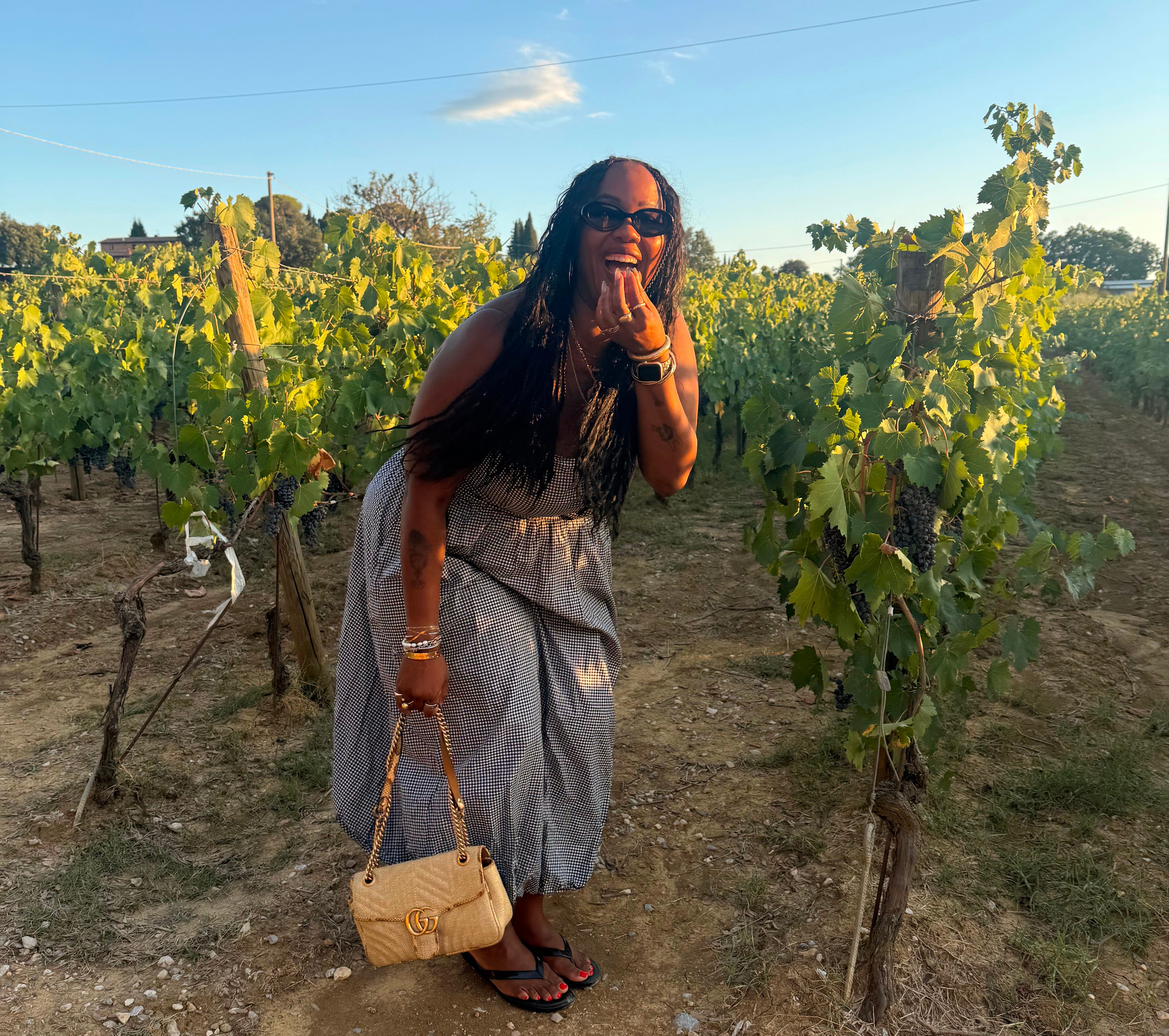
Ciao! I’m writing this as I sit poolside at my Tuscan agriturismo, just outside of Montepulciano. I just made a poolside cocktail, and honestly, this may be the most relaxed I’ve been this entire week. We don’t talk about this enough, but Europe is exhausting. Especially when you are going to multiple cities and catching numerous trains like I am - and you’re doing it solo. Not to mention, all of Europe was impacted by extreme travel delays and cancellations, including my flight, on the day that I left LA. This resulted in me having to pay for double hotels and spend an unforeseen night in Milan. But, I was in Italy! So, I remained positive through that, running for trains, hauling luggage down city streets, sweating - so much sweat, downpour rain, and so much money wasted. I just want to be clear that having a Euro summer is not all sunshine and spritzes. We keep it real, in the corner!
Now that that’s out of the way, I’ve officially been in Italy 9 days and it feels like a crash course in Italian wine…and life. Here’s what I’ve learned so far, about myself, about Italy, and about wine.
Aperitivo & Cheap Italian Wine
At the end of 2025, I made the decision that every year I would take a solo trip dedicated to wine, starting with 2026. I didn’t really think about it much until one morning about a month ago I woke up and was struck with fear that I had forgotten that promise to myself. I decided I was going to Italy on the spot, I bought the plane ticket an hour later. I would also be remiss to mention that it’s this very substack that inspired me. So, thank you for reading.
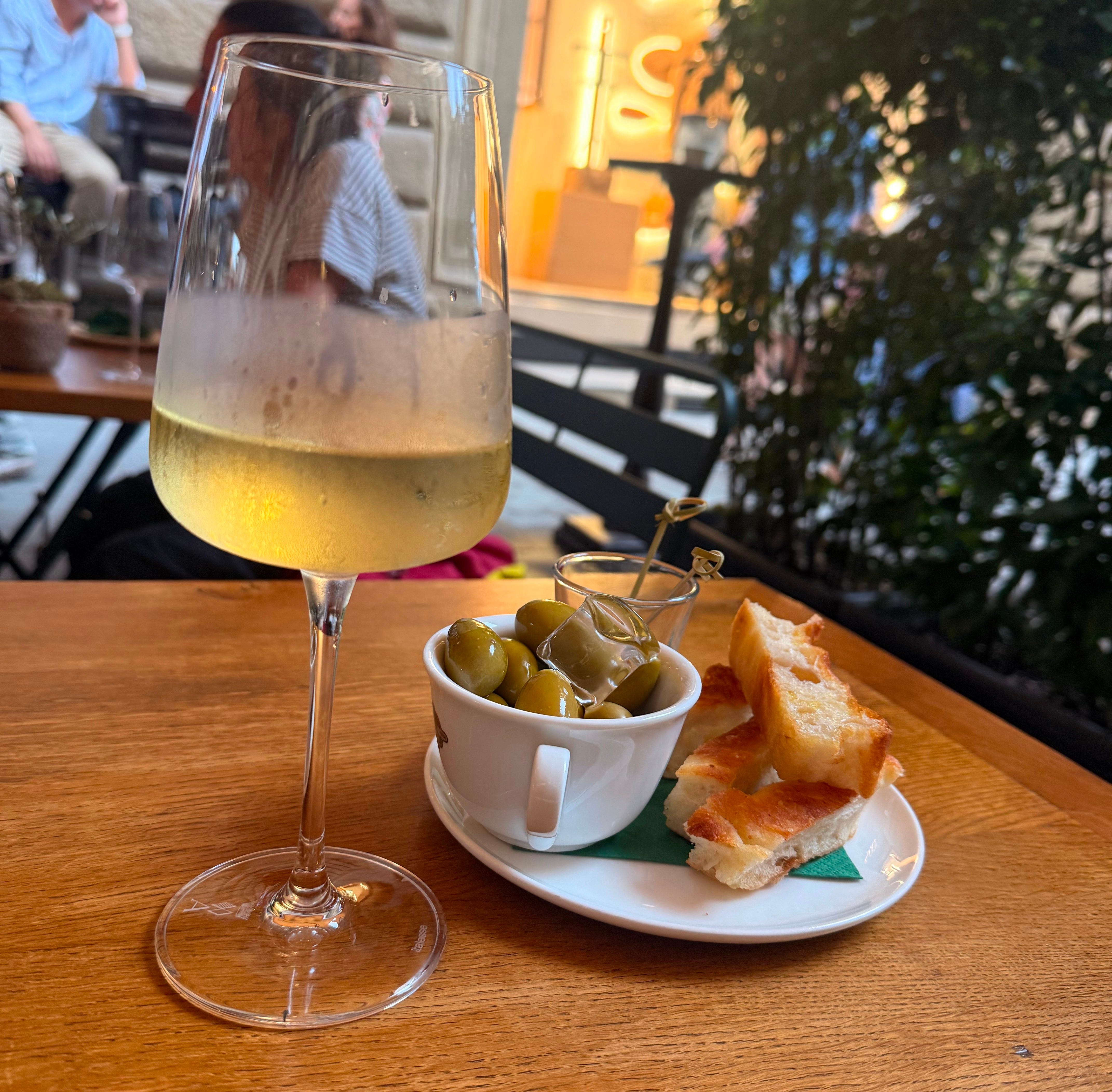
But, why Italy? To be honest, I don’t know, I think I imagined myself drinking wine and eating cute snacks. I imagined aperitivo. And no one does it better than Italy. I wanted to start here, because I think the drinking/wine culture in Italy is just special. What do you mean I get free snacks for ordering a drink? What do you mean it’s customary that you should always have a bit of food with your alcohol? It’s fascinating as an American, where you breathe near a bar/restaurant and it costs money.
Aperitivo (Latin for “to open”) in Italy essentially means: You order a drink, you get snacks to go along with that drink - free of charge. I think this says something about their culture and how drinking plays a part, it’s meant as a digestif before starting a meal, but I think it tells a larger story about how they enjoy alcohol here. It’s a slow down, a moment to digest, a ritual. That’s really a lost art in other countries.
And that drink you ordered? It was only 5 Euro. And, it was phenomenal. Here’s why:
The supply chain is shorter, in most cases it was made down the street
Wine isn’t a luxury product here, it’s a vital part of every day life
Wine is good and accessible on almost every corner, this competition keeps costs down
And that aperitivo snack you’re having with the wine, it’s not random, Italian wine was created and evolved based on the food of the region. The wine tastes better because it was expertly paired
There’s also this interesting myth that you can drink Italian wine all day and wake up the next morning feeling refreshed, let me be the first to tell you, that is in fact not true. But, I do think aperitivo helps slow down the process a bit, and for that I’m thankful.
Lesson #1: Slow down, savor this moment, smell the wine. Every moment in this life is meant to be enjoyed, even the little moments. Il dolce far niente (“the sweetness of doing nothing”)
Pasta & Prosecco
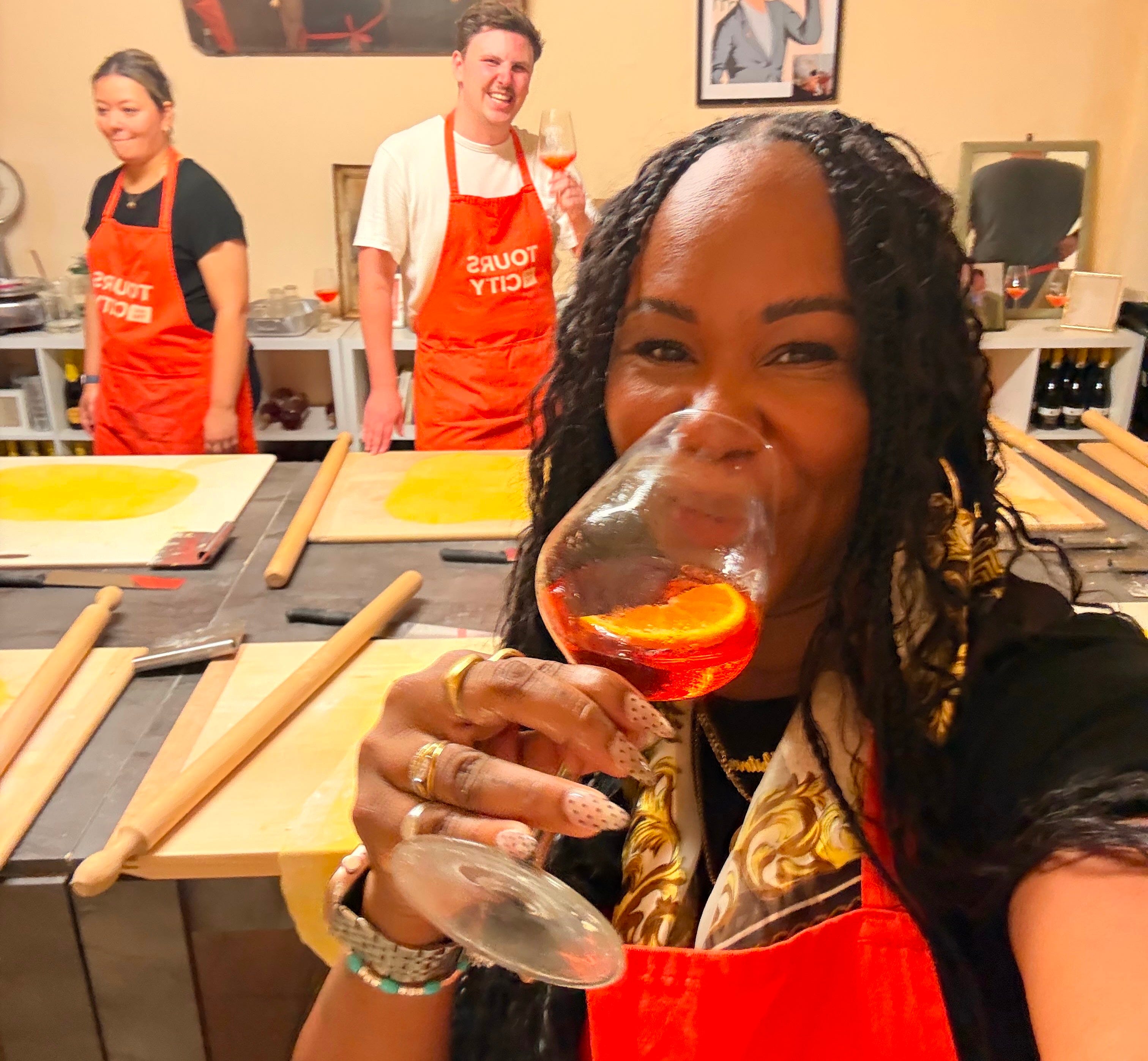
I’m covering a lot of ground on this trip. I started in Milan (unforeseen), went to Florence for leg 1, Montepulciano for leg 2, and then Siena for leg 3. While I was in Florence, I decided to take a day trip to Bologna, the birthplace of egg pasta. It’s been on my list for years, ever since Evan Funke said it was the place where he fell in love with pasta and learned to become a master. Naturally, I booked a pasta making class. It was fun, and the pasta was amazing, but there was a larger truth that came out of the trip: pasta and prosecco belong together.
Prosecco comes from northeastern Italy, primarily Veneto and Friuli-Venezia Giulia. Bologna’s own signature wine is Pignoletto, but it was prosecco that was offered to me to open up my palate. Bolognese food is rich and not shy with flavor, the bubbles reset your palate with it’s acid and freshness - cutting right through that fat.
This got me thinking…maybe the best Italian pairings aren’t about rules. They’re about rhythm: pasta, wine, conversation, another bite. And if Bologna taught me anything, it’s that sometimes the right wine isn’t the one you’re supposed to order. It’s the one that makes you want to stay for another plate of pasta.
Please give this a shot next time you make a bolognese or rich pasta, you won’t regret it, I promise.
Lesson #2: There are no rules, life is built on testing and breaking what we think we should be doing. There’s freedom in finding your own rhythm.
Tuscany, A Sangiovese Love Story
Once it was time to leave Florence for Montepulciano, my trip was hit with yet another unfortunate blow. The rental car I booked? They misinterpreted the reservation and sadly only had manual cars left once I arrived. I unfortunately, do not drive stick shift. I took it as a message from God that maybe I shouldn’t be driving and hauled my luggage one mile on foot to the train station. Sadly, my agriturismo is very remote. A car is not optional, it’s a requirement. There goes all my plans to visit wineries throughout the region.
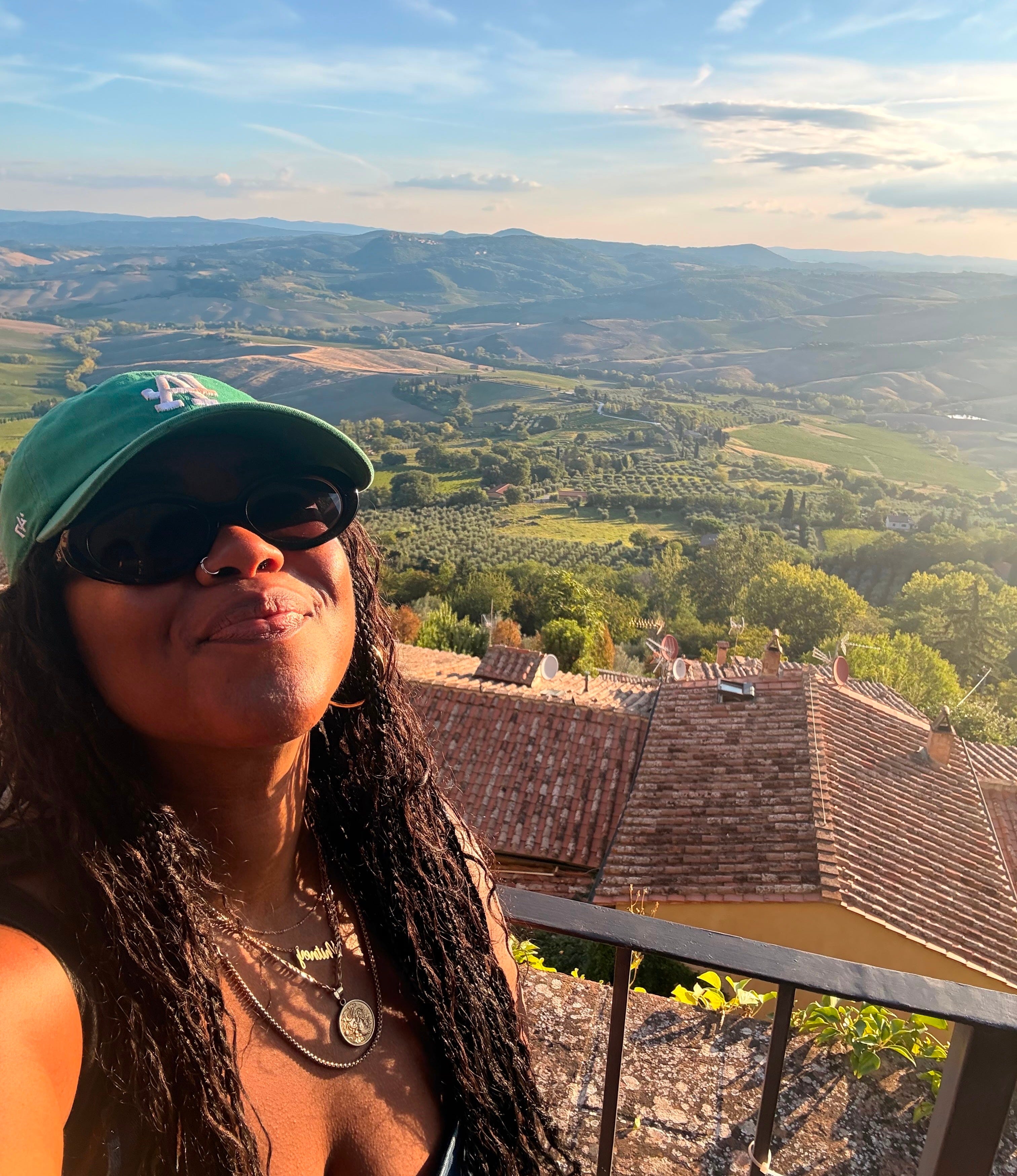
But, when life throws you a curveball…you must learn how to catch. That’s what brought me to standing at a bus stop in the middle of nowhere, under the extremely hot Tuscan sun. After 30 mins, a bus actually showed up! I was saved, and I took it to Montepulicano’s old town, an area full of tasting rooms. I went for one particular tasting room, and I walked into the wrong one by accident. That was the best accident of my entire trip.
The sommelier (Gilberto) I met there spent 2.5 impassioned hours telling me (just me, there was no one else there) the greatest love story ever known: Tuscany & Sangiovese. I was beyond grateful for that experience, I learned more in that time about Italian winemaking than I did during my entire Level 2 class. Here’s the magic of Sangiovese in Tuscany: it's not one flavor profile. It's almost like a dialect. The grape changes its expression as the landscape, elevation, soils, climate, and winemaking traditions change. Sangiovese is actually one of Italy's most widely planted grapes, making up about 11% of the country's vineyard area and there are more than 100 identified clones. But Tuscany is where it became particularly emblematic
Never in my life had I ever met someone so fervent on their love of a grape. If you’re reading this Gilberto, I hope I make you proud. Here’s an impossibly quick guide on how to think about Sangiovese when selecting Tuscan wine (because in the end, all roads lead back to Sangiovese here):
Vino Nobile di Montepulciano: Not to be confused with Montepulciano d'Abruzzo. this must be 70% Sangiovese. It’s usually made with clay soil and made inside HUGE barrels, their clone is called: Prugnolo Gentile. You’ll get cherry, herbs, spice, lots of acid and tannin. There is also Reserva, which spends a bit more time aging and is usually more complex.
Chianti Classico: More savory and floral notes than the Nobile. Must be made with at least 80% Sangiovese, but usually 100%. Gilberto’s favorite for its elegance and structure.
Brunello di Montalcino: Must age for 5 years and must be made with 100% Sangiovese. Montalcino's warmer, drier conditions and varied elevations produce a more powerful, concentrated expression, with dark cherry, dried fruit, earth, spice and serious tannic structure. It’s a powerhouse in the region and usually pretty pricey.
And please believe me when I tell you this is just the tip of the iceberg, but this was what I focused on within our session, picking up on the subtle differences of each and learning how each region used art + science to distinguish itself, from the barrels used to the how sand provides more minerality than clay. To be honest, I’m still processing this session and how lucky I was to experience it.
Lesson #3: Art comes from taking what’s normal or traditional, and finding a way to distinguish yourself. Maybe it’s the soil that’s different, or the location under the sun, the beauty is finding your own path.
From Montepulciano, With Love
I’m still trying to wrap my head around the wine of this region, but I would be remiss to not mention that Montepulciano was an oasis for me on this trip. Florence and Bologna were crowded and felt deeply impersonal. Once I got off the bus in old Montepulciano, there was a shift. There were tourists, but not nearly as many. I had conversations with shop owners in my broken Italian, I met the sweetest gallery owner that hugged me numerous times and called me his daughter, and of course there was Gilberto. This little town was the Italy I signed up for.
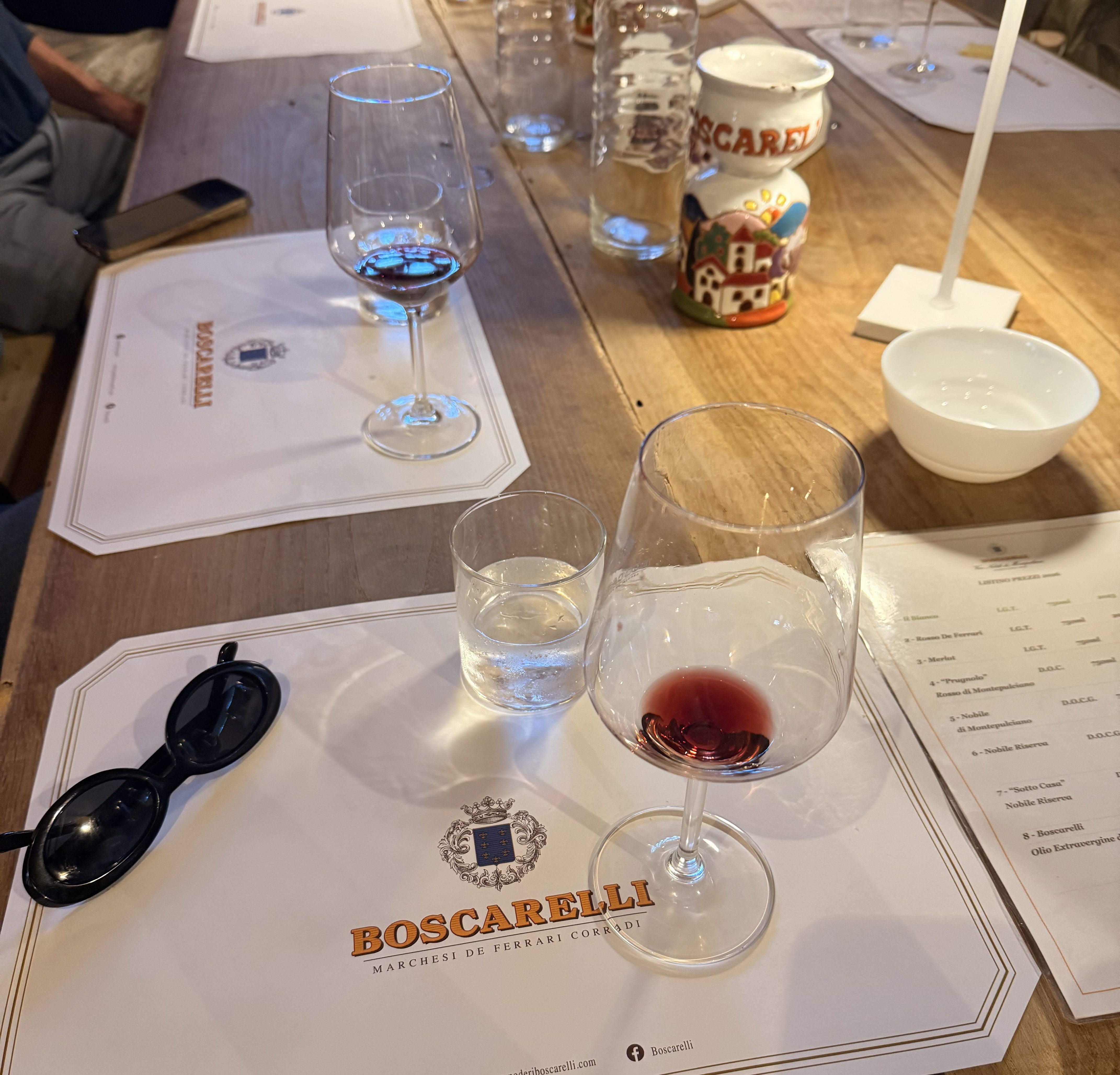
I also had the incredible privilege to visit Boscarelli Winery, a small family owned winery on the outskirts of Montepulciano. My friends Raisa and Semhar were passing through the region, and like angels sent to come save me, they came to pick me up for wine tasting and frolicking around town. It’s amazing how incredible it can feel to see a familiar face after a week of making small talk to strangers.
Boscarelli was everything I was hoping for and more, we tasted grapes off the vine (maybe the best grapes of my life), we toured the fermentation, and the aging rooms, and we tasted their full wine offering. But, my favorite part of the tasting was at the end when our guide came out with what he called “meditation wine.” I was beyond confused. He explained: “Italian wine was made to accompany the food of the region, but with this wine, we ask that you just sip, sit, and think.” I had never thought about wine in the context of meditation before. But, it was always there. I have been doing it all along. My life is so uncertain these days, it was wine that has been anchoring me. Forcing me to sit and smell, and think and taste. To be present. Wine IS meditation.
Our guide also asked us to drink the wine and guess the grapes within, it was their IGT wine, so not restricted to Sangiovese only. I closed my eyes, took a sip, and guessed it immediately. I couldn’t have been more proud.
Lesson #4: Find your life’s anchor, something you can hold on to when the waves of life are crashing in. Bonus points if it tastes really good.
This was so beautiful and so beautifully written. I was immediately transported to every place you visited. Your words are powerful more than you know. Just when I thought I’d never return to Europe, it’s back on the list. What a memorable and beautiful experience.