


If there’s one thing I love, it’s an underdog. And to be clear, I’m talking about South Africa, not natural wine, more on that later. Wine insiders adore South African wine, but when I mentioned it in passing to a friend recently I was met with a blank stare. We cannot have that, more people need to know how incredible South African wine is! Therefore, you are officially invited to the beautiful, wild world of South African wine making. Six weeks of it to be exact. I hope you’ll stick around, we have much to learn together.
Also, for those of you wondering, I am in my final week of my alcohol break. This was an enormously refreshing pause, but I can’t wait for my first sip of wine come Saturday. I broke down and bought another NA wine, it was awful. No need to discuss it. But, this did get me thinking that I may take more of these breaks. Could I be the world’s first ever sober-curious sommelier? Who’s to know. Anyway, on to South Africa, natural wine scams(?), and a Cab Franc that punches way above its weight.
Regional Spotlight: Six Weeks of South Africa - Stellenbosch
Back in 2008 I went to South Africa for the first (and sadly only) time. It was an iconic family vacation, and lives in my memory as one of the best adventures of all time. We did safaris, stayed in some of the most exotic and stunning locations, ate ostrich (sorry!), and for the very first time I heard the word: Pinotage. But, more on that in a moment.


When we talk about wine, South Africa is rarely at the forefront of the conversation. That’s just an unfortunate fact. Even when I was studying wine, we spent weeks on France and Italy, and only a few moments discussing South Africa. There could be a multitude of reasons why, but I think it deserves more discussion and praise than it’s currently getting. And for the record, it’s not the only country that deserves more praise, this will be the first of many series diving deep into lesser known wine regions, so buckle up.
Now, back to Pinotage. This was my first introduction into South African wine, and my first inclination that something very interesting was happening there, that we in America knew nothing about. To be clear, I didn’t taste it on that trip. I was 19 and traveling with my parents after all. But, I don’t think it’s a coincidence that I still think about it today. So, before we get into our first region, let’s discuss the varietal that opened up my curiosity.
Pinotage is South Africa's signature grape, and its story is deeply tied to Stellenbosch (our first region!) as that's literally where it was born. According to WSET (where I studied), the varietal came about in 1924 when a Stellenbosch University professor of viticulture was performing "open-air hybridisation.” Shortly after that in 1927, he quit (relatable) and his garden became untamed and wild. As the university was sending in a cleaning crew a young lecturer happened to walk by and also happened to know the work that the previous professor had been doing. He rescued the seedlings on the spot. And that, ladies and gentlemen, is how we got our mutant beauty, Pinotage.
Here’s what you need to know. It’s a cross of Pinot Noir × Cinsaut, despite it’s birth it’s vigorous, relatively easy to grow, and heat-tolerant. It buds and ripens early, and can produce high yields. It’s deep, dark ruby to purple (much more intense than Pinot Noir), and has a smoky, earthy, and dark-berry fruited (blackberry, plum) flavor profile. It’s also known for a distinctive note that people either love or hate — often described as banana, bubblegum, or nail-polish/acetone-like (I like it). It has medium-to-high tannins, decent acidity, and generally a fuller-bodied, robust wine — closer to Syrah or Zinfandel in weight than to Pinot Noir’s silkiness. It was dismissed for decades as a rough, low-quality bulk grape, but a wave of quality-focused Stellenbosch and Swartland (coming soon) producers since the 1990s–2000s has rehabilitated it into a genuinely serious, distinctly South African wine.
But, that’s not all Stellenbosch is good for. It’s our first region because it’s South Africa's most famous wine region, located about 30 miles east of Cape Town in the Cape Winelands. It has a Mediterranean climate, warm, dry summers and cool, wet winters, moderated by cooling breezes off False Bay to the south. It has the country's oldest wine-growing history (dating back to the 1670s), the greatest diversity of soils and mesoclimates (thanks to several mountain ranges creating varied aspects and altitudes), and the deepest concentration of top producers, research institutions, and investment.
It excels particularly with Bordeaux-style reds (Cabernet Sauvignon, Cabernet Franc, Merlot blends) and increasingly fine Chenin Blanc and Syrah. If you want one region that showcases South African wine at its most polished and prestigious, this is usually it. Ready to give it a try? Here are some producers that I would recommend, and as an added bonus all are Black owned:
M’Hudi Wines : It’s one of the oldest and only Black-owned wine farms and wine brands in Stellenbosch.
Seven Sisters Vineyards: One of the first and few 100% POC-owned and managed wine farms in Stellenbosch, established in 2009.
Carmen Stevens Wines : Carmen Stevens was the first Black South African to study the art of winemaking in South Africa.
Aslina Wines : Founded by the first Black female winemaker in South Africa, though her wines are made using grapes from various Cape regions rather than a single home estate.
Klein Goederust and Ovation & Thokozani : Was voted Best of Wine South Africa-Authentic South African Experience in 2023 and their vineyard was named TIME World’s Greatest Places of 2022.
Wine in Culture: Do We Really like “Natural” Wine?
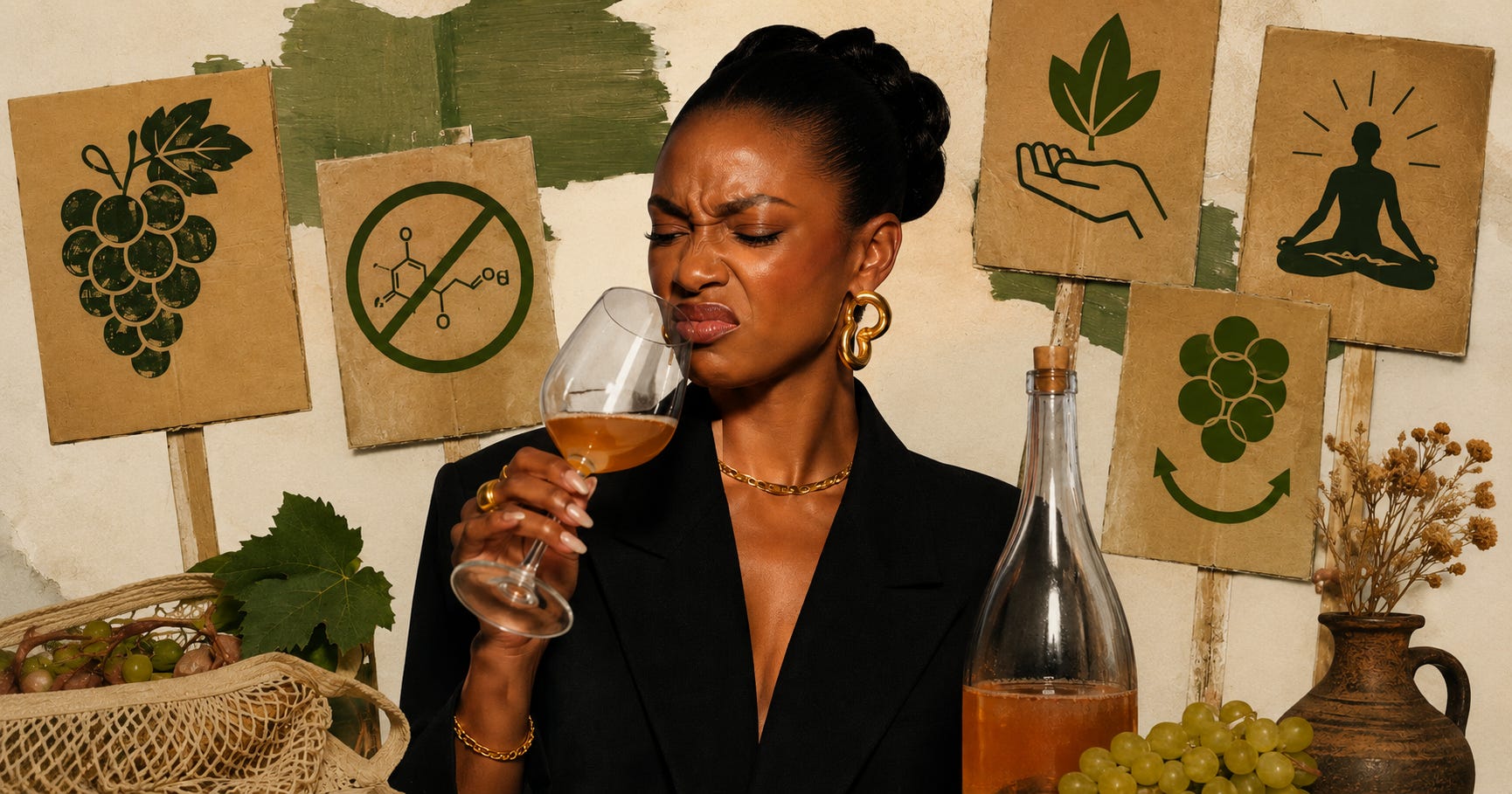
Natural wine is having a moment. Personally, I’m not a huge fan and I don’t know if I ever will be, but I admire the tenacity. To me, most “natural wine” tastes like vinegar at its worst and grainy at its best, also the hangovers are not in fact better. So, what’s making everyone so hot for natural? This week in culture, we’re going to break down what makes it “natural” and why that’s a good or bad thing for you.
Here’s the thing. There’s no legal or universally agreed definition (unlike “organic,” which is certified) for what makes “natural” wine, it’s more of a philosophy/movement than a regulated category. Therefore you will constantly see debates about what actually “counts” and why the quality is all over the place. It’s more of a ~ vibe ~ and less of a real thing, if you get my drift.
The simplest way to define it is minimal intervention, both in the vineyard and the cellar. But, I guess that doesn’t have the same ring to it.
In practice that usually means:
Organic or biodynamic farming — no synthetic pesticides/herbicides, healthy soils
Native/wild yeast fermentation — no commercial yeast strains added
No or very low added sulfites — sulfur is the main preservative in conventional wine; natural wine either skips it or uses tiny amounts
No additives or manipulation — no fining, filtering, acidifying, sugar adjustment, tannin powders, coloring agents, etc. that are common (and legal) in conventional winemaking
Nothing added, nothing removed
This hands-off approach can produce more distinctive, terroir-driven wines, but also makes them less stable and more prone to funky, unpredictable flavors since there’s less chemical safety net. And that vinegar you’re tasting, that’s volatile acidity (VA) and you’re tasting it because there is no sulfur dioxide (the safety net) to keep this bacteria in check and off your tongue.
Why drink natural wine? The natural wine lobbyists (whoever they are) say it gives drinkers less of a hangover, but there’s no solid scientific evidence that natural wine causes fewer hangovers than conventional wine and I can personally attest to that. They say it’s healthier, which is not substantiated. It’s still wine - alcohol is alcohol. Some say it’s “more pure/authentic,” this is largely a philosophical/values statement (rejecting industrial winemaking) rather than a measurable quality benefit. But, most say it’s less sulfates, which is 100% true, and if you are sulfate-sensitive I’m glad you have your wine. So can we put this to bed? The answer is no, it’s not better for you.
I think the real draw for most people is taste and philosophy, not health. Natural wines can be genuinely exciting and different, funky in an interesting way, and appeal if you like supporting smaller-scale, lower-intervention farming. However, quality is less consistent than conventional wine, and if you are anything like me - that’s a problem.
In conclusion, I think it’s more of a trendy movement and less of a wine category, but it does put a spotlight on sustainability so that’s not a bad thing. From my perspective, I’ve had some wonderful organic and biodynamic wines, and I promise, I’m not saying that ironically.
So, do you really like natural wine?
What’s in my Glass: Chateau de Parnay Saumur Champigny
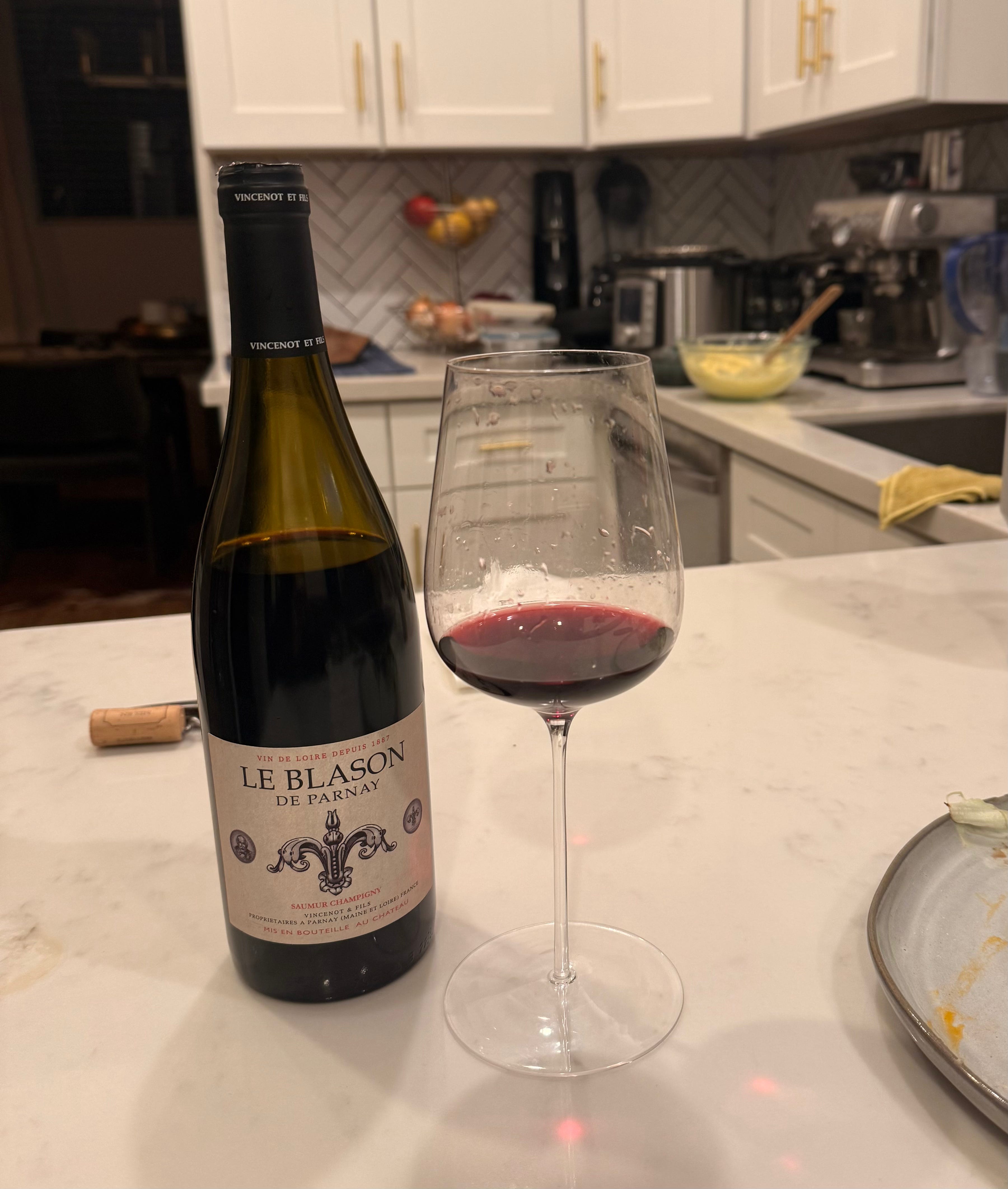
Going back into the memory bank this week. Last fall, I saw an Instagram video about Anna Wintour’s daily lunch. I became obsessed with the mashed potatoes, they were a classic french style that was basically a lot of butter. I went out and bought all the supplies and groceries. And, I thought long and hard about the wine pairing. It needed to be French, of course, but it also needed to be decadent and have enough acid to cut through all that fat.
Enter Chateau de Parnay Saumur Champigny. Made from old-vine Cabernet Franc, the taste notes are ripe red fruit, mint and spice, with a structured, silky, well-balanced palate and notably long finish. It’s been described as “dark fruit and cassis with peppery, grassy notes, dense and fresh with ripe, grainy tannin.” Oh, and it’s organic. It was approachable, had a very pronounced floral aroma, and let’s just say I savored every drop in one sitting.
When it comes to the winemaker, Château de Parnay is a historic vineyard in the Saumur Champigny appellation. The property sits along the Loire River, overlooking it from a white stone cliff, and today covers four separate plots of exceptional clay-limestone soil.
Basically, it was excellent. It made my meal feel restaurant quality and oh so expensive. But, here’s the good news, it’s not that expensive. On average, you can get this bottle for about $35-39 if you look for it. I found mine at K&L in Los Angeles, but it’s sold nationwide. This is the perfect companion for a dinner party or a way to elevate your meal without breaking the bank. Trust me on this one.
Great information Whit. Having recently visited CapeTown, I did have an opportunity to visit Stellenbosch and do some wine tasting. The wine there does have a spectacular reputation.