


I’m in week two of my alcohol break and I hate to report, I feel great. Inflammation is down, I’m sleeping better, my brain feels sharper, and my Oura says I’m basically super woman. I don’t miss wine, yet. But, I do miss the act of drinking wine (and let’s be real, a martini with a twist). It’s the ritual, the discovery, the story. I really do love wine with all my heart. But, I also know it’s not great for me. I can see it in my face almost instantly and I can feel it in my body for days. How can something so wonderful also be so bad?
So, I’m determined to find wines that allow me to still be super woman while having a glass or four, that’s the big topic for this week because let’s face it - a life without wine is not the life for me. Also, we’re discussing one of my favorite wine regions in the world this week and a truly unforgettable sip I had last year for what’s in my glass. And for the observant readers, you’ll notice a new section has arrived, you’ll have to read on to find out what it is.
Regional Spotlight: Sancerre, France
We have arrived at peak summer. It’s hot everywhere, people are musty, summer travel is all over IG, and everyone (and I mean everyone) is outside. This means one thing to me: It’s time for summer wine to shine. I have a lot of summer wine favorites, Albariño is #1 on my list, but there’s also Gavi, Provence rosé, Soave…and Sauvignon Blanc. But not just any Sauvignon Blanc, the crème de la crème - Sancerre. I know everyone loves a New Zealand SB, and based on previous editions of this newsletter one could say I also dabble with California, but nothing feels like summer to me like a Sancerre. It’s pale, bright, and bone-dry, absolutely no sweetness to speak of (more on that later). It’s high in acidity but this only makes it more crisp, zippy, and refreshing. Of course, it’s aromatic, smelling of citrus (grapefruit, lime), green apple, and often grassy or herbal notes. It’s usually light-to-medium bodied, so you can take down an entire bottle to yourself and basically feel like you’re drinking water. And finally, it’s unoaked in almost all cases, so the fruit and minerality stay front and center. It really is perfection in a glass. To me, it’s Sauvignon Blanc at its most classic and restrained and exclusively belongs pool side, on a beach, on a boat, on the street at a cafe in Europe, and in air conditioning on my couch.
So, why is it called Sancerre and what makes it so different? First the name. Sancerre is a legally protected Appellation d'Origine Contrôlée, the name refers to a specific place with defined boundaries, soils, permitted grapes, yields, and winemaking rules. Under this system, the label tells you where the wine is from, and it's assumed (or you're expected to learn) what grape is grown there. So a bottle labeled "Sancerre" is legally guaranteed to be Sauvignon Blanc (for the white), grown within that appellation, and made under those rules. The name Sancerre is actually doing more specific work than "Sauvignon Blanc" would, because it also tells you the soil, climate, and style.
So, let’s talk about that soil, there are three main soil types across the appellation’s vineyards:
Silex (flint) — gives the most smoky, mineral, “gunflint” character
Caillottes (limestone pebbles) — produces lighter, more floral, fruit-forward wines, often the easiest-drinking style
Terres blanches (marl/clay-limestone) — gives fuller-bodied, more structured wines that can age longer
As for the climate, Sancerre (the region) sits in the eastern Loire Valley, on the river's left bank, centered around the hilltop village of Sancerre itself — a medieval town perched above the vineyards with views across the river to Pouilly-Fumé on the opposite bank, and for the record they also make great Sauvignon Blanc. Due to this location, the climate has cold winters and warm-but-not-hot summers. That keeps acidity high in the grapes, which is core to Sancerre's crisp signature.
And when it comes to style, they are refined and you can really taste it in the glass. Their goal is to preserve freshness and let the terroir (soil) show through, rather than layering on winemaker technique. That’s why you can’t find many Sancerre’s that are oaked (this a technique flex), they typically use stainless-steel in this region. Also, they harvest those grapes by hand, at least that’s what they say, and you know what? I believe them.
Wine in Culture: Everyone is Protein-Maxxing
Is it just me or is everyone protein-maxxing? Whether it’s GAINS or using protein to shed a few, it’s all over my algorithm and it’s not just the gym bros anymore. For the record - I too am a protein maxxer. I am constantly trying to reach my protein goals each day and I cut sugar and carbs every chance I get. Here is how the American Medical Association describes it:
"Protein maxxing" (or protein-maxing) is a popular internet wellness trend centered on maximizing daily protein intake to boost metabolism, manage weight, and build muscle. It involves deliberately pushing protein consumption to the upper limit (often exceeding 2.0-3.0g per kilogram of body weight), while tracking every gram and heavily utilizing supplements.
But, is that any way to live?? So, today, we’re going to discuss some of the wines that won’t take us all the way off plan and allow a little fun in while we’re maxxing or whatever the kids are saying.
First, let’s discuss the bad news. Wine (or any alcohol) doesn't fit cleanly into a protein-maxxing goal, let’s say the quiet part out loud: alcohol calories are "empty" (no protein, no nutrients), and alcohol also temporarily suppresses muscle protein synthesis and takes metabolic priority over fat oxidation when you drink it. TLDR: your body burns off alcohol before it burns fat, because it doesn't store alcohol. So if you're heavily prioritizing protein/training, wine (or any alcohol) is working somewhat against you regardless of sugar content. Ok, it’s out there now. But, here’s the good news: Not all wine is created equal. So, there are some wines that won’t completely derail your goals. So, let’s focus on that.
Let’s debunk something. It’s not the sugar in the wine that leads to problems (I was guilty of thinking this too), sugar has its own issues, but if you are trying to stick to a fitness goal, you really have to focus on the alcohol content. If you are cutting sugar though (which I also do) dry wines have very little residual sugar — typically under 1-2 grams per 5oz glass. However, the calories in wine come almost entirely from alcohol itself (7 cal/gram), not sugar. So "low sugar" wine is a gimmick, the goal here should be picking lower-ABV options.
With that in mind, you can ditch all those low sugar marketed wines and focus on good quality varietals . Here are some that I really love:
Vinho Verde (Portugal) — ~8.5-11% ABV
Light, slightly effervescent, citrusy white. One of the lowest-ABV table wines you’ll find that’s still widely available and good. Great for summer!
German Riesling, Kabinett level — ~7.5-10% ABV
Kabinett is the lightest tier in Germany’s ripeness classification. Can range dry (Trocken) to slightly off-dry (check the label). It’s naturally low alcohol because Riesling grapes retain acidity and sugar converts to alcohol less fully at cooler ripeness levels.
Moscato d’Asti (Italy) — ~5-6.5% ABV
Very low alcohol, lightly sparkling, aromatic. Worth noting: this one is sweet (residual sugar), so if you’re also watching sugar, lowest alcohol on this list, but not lowest sugar.
Prosecco (Italy) — ~11% ABV
A bit lower than Champagne (which usually runs 12-12.5%), and the bubbles can make a glass feel more satisfying, which sometimes helps you drink less (not me). Focus on Veneto and Friuli-Venezia Giulia regions.
Lambrusco (Italy) — ~8-11% ABV
A light, fizzy red, it’s unusual but a legitimately good lower-ABV red option if you want something other than white/sparkling. Look for “dry” on the label and it’s best from Lombardy (in my opinion).
Txakoli (Spain, Basque Country) — ~9.5-11% ABV
Bright, briny, slightly spritzy white. Similar profile to Vinho Verde.
Muscadet (Loire, France) — ~11-12% ABV
Not dramatically low, but on the lower end for a still dry white, and very clean/crisp.
More good news: most of these are great for summer. Just make sure you’re checking the label in case the producer got a little overzealous, look for 11% ABV and lower. And, here are a few that should be on your no-sip list: Napa Cabernet, Zinfandel, Châteauneuf-du-Pape, and other warm-climate reds often run 14.5-16% ABV, double some of the wines above. Fortified wines (Port, Sherry, Madeira) are even higher, 17-20%+.
If you are avoiding sugar but you aren’t as concerned about ABV (or calories), here are some options for you:
Sancerre and other dry Sauvignon Blancs (don’t you love when things come together)
Dry Champagne/sparkling labeled Brut Nature or Extra Brut (avoid “Demi-Sec” or “Doux,” which are genuinely sweet)
Dry Rieslings labeled Trocken (German for “dry”) — Riesling has a sweet reputation but Trocken bottlings are bone-dry
Pinot Grigio, Albariño, Grüner Veltliner — all typically fermented fully dry
Dry red options: Pinot Noir, Cabernet Sauvignon (not from Napa), Sangiovese (Chianti) — reds are almost always fermented dry with negligible sugar
Moral of the story: where there’s a will, there’s a way. Drink the damn wine, life is short.
What’s in my Glass: Baskoli Hondarrabi Zuri
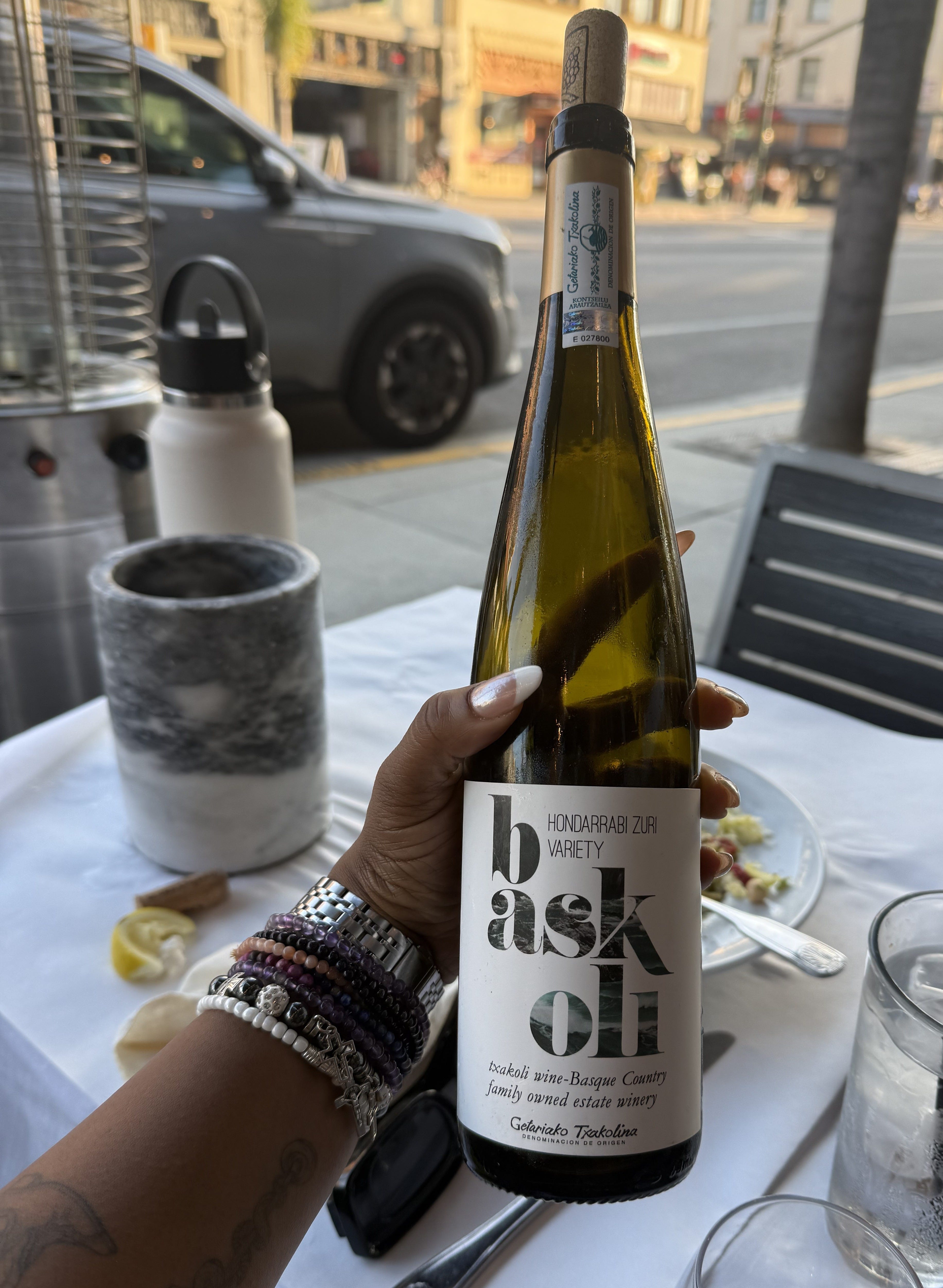
As we all know, I’m not drinking at the moment. So, I’ve been pulling from memory to curate this section over the last two weeks. And, I must say - this was a very memorable wine. I met this wine whilst enjoying a Sunday funday in Pasadena last year (yes, it’s been that long - and sadly I don’t remember the restaurant, ironic). And, when I told the staff that I was studying wine, they rushed to bring this bottle out. This, ladies and gentleman, is Baskoli Hondarrabi Zuri. Sidenote: one of the fun parts about studying wine is meeting wine sommeliers in restaurants. They are always so eager to give tips or in this case…quiz you. I was offered a sip of this wine and the sommelier quickly followed with: “tell me the notes!” I was put on the spot, but honestly, it was easy - this wine danced on my tongue. I responded with “grapefruit, pear, and…..coconut?” A huge smile took over his face and he clapped. “Well done, so many people miss the coconut, but it really stands out to me.” I couldn’t agree more, it’s such a distinguishing feature and very unexpected. It also has bright acidic features, but is also so delicate and complex. I can still taste it now. But, you’re probably wondering…wtf is Hondarrabi Zuri? Here’s how the producer (Riboli Family Wines) describes the region and grape:
Baskoli is not only a winery… it is a philosophy of life. Our passion and love of the world of wine was what inspired us to create our own txakoli winery in one of the most beautiful locations in the Basque Country: Hondarribia. What was once a shared dream is now a reality. A tradition lost in the 17th century has been recovered thanks to our commitment to recover and revitalize this cultural winemaking heritage for the people of Hondarribia. Very aware that the key to a great wine is to have the best grapes, we strive to take care of the day-to-day of our vineyard. The weather, soil and crop type are the keys to our exceptional terroir. Our trellis-planted vineyard is located in a privileged, south-facing location, with maximum solar radiation and benefiting from the sea breeze from the Jaizkibel cliffs. The native grape, Hondarrabi Zuri, is the most important in our plots. All of this allows us to produce wines with their own particular style.
Basically, Hondarribia is a historic coastal town in the Basque Country of northern Spain. The grapes are grown on the foothills of Mount Jaizkibel (say it slowly lol), and the wine is fermented at the estate overlooking the Atlantic Ocean. The wine falls under the Getariako Txakolina (Denominación de Origen) region. It is produced by the Baskoli winery, which is a family-owned estate. And this is important because Basque Country wine has it’s own story and approach - much different than the rest of Spain, but that’s a topic for a different day.
All I can say is, this wine is spectacular. It was early summer when I tasted it and it felt perfect for a sunny day, but I could also see it as a great companion for just about anything. You can learn more about the producer here and please trust me, if you see this anywhere - grab it, don’t even think about it.
The Hangover: Final Thoughts
I’m really enjoying doing this newsletter, I hope you’re enjoying reading it. It’s forcing me to do research each week and pick up that damn text book. For that, I’m thankful - the wine world requires A LOT of studying. But, I want to hear from you! What are you liking? Do you want any regions or topics discussed? Tell me in the comments. And lastly, don’t forget to share this with your favorite wino.
And, you may have noticed a name change. I love WWC, but I want this to feel welcome to all that are wine curious - it’s our little corner of the internet where we can all have a good time and drink wine :) I’m so glad you’re here in The Wine Corner.
It really is a balancing act trying to be somewhat health-conscious while also loving the ritual of a glass of wine. Albariño and Sancerre all summer long!
My first job when I moved to NYC in 2011 was working at a beer garden. We had a short wine list for the IPA-opposed. Sancerre was on there and from my first sip, I was hooked! It’s been a love affair ever since - truly, my fav wine of all time.
Important to note: Coming from Ohio, up to that point all I knew about alcohol was Bud Light and my grandma’s mimosas. Sancerre was a significant step up and I didn’t even know it at the time. 🤣