



This past weekend, I hosted my third wine tasting event in LA. I’ve been doing them quarterly, with each one focusing on a different country, broken up into regional segments. They are a lot of work, but worth it every single time. This one was dedicated to Spain, a country near and dear to my heart, and also the place that cemented my love of wine. I studied abroad in Barcelona in 2009 and learned the art of wine with every meal, pairings, and I completely fell in love with Cava. It changed my entire relationship to wine which before that was very much “slap the bag.” It now brings me so much joy to build community around that love of the grapes and spend an evening laughing and drinking wine with friends.
Sadly, according to statistics events like this could start becoming few and far between in the years or decades to come. Unlike Millennials, it’s reported that Gen Z are simply not drinking wine - or anything for that matter. Is it a good thing? Maybe. But, it also hits me with a sting of sadness. Wine is more than just a drink, it’s art, it’s storytelling, it’s history. Could one generation wipe all of that away? Let’s get to the bottom of wtf is going on with Gen Z and if the rumors are in fact true.
Regional Spotlight: Penedès
Before we go full blown elder millennial, let’s take a pit stop in Penedès, Spain. As mentioned, Barcelona is where I fell in love with Cava. This makes sense because Catalonia is the home of Cava, and most importantly, Penedès.
When talking about wine’s ancient history, this region must be a part of the conversation. Located just outside of Barcelona, the region runs from coastal areas near the Mediterranean to the mountains, and dates back to 7th Century BCE. Archaeological evidence shows viticulture and wine consumption during that time, they are not new to this, they are true to it.
Cava is made exactly the same way Champagne is made, using the traditional method, which basically means that the wine goes through its second fermentation in the bottle. That’s where those delicious bubbles come from. The difference is in the grapes that they use, all indigenous to Spain:
Xarel-lo: Pronounced, sha-rell-oh, this lemony, herby grape gives Cava its acid, structure, and texture.
Macabeo: Gives it freshness and floral flavors
Parellada: Provides aromatics galore
The interesting thing about Cava, is that it can be made anywhere (unlike Champagne), so while these are the traditional grapes, there’s some variation, this also means that cost and quality varies greatly. You can count on it to be a much cheaper option, especially the Costco version, which in my humble opinion is an unsung hero at just $5.99.
If you want something specific to Penedès, and possibly higher quality try a Corpinnat varietal. This wine collective was born out of some wine drama in the region from producers who felt Cava was not prestigious enough (my interpretation), so they made their own collective. There’s also Clássic Penedès that is slightly higher quality than Cava, with a minimum of 18 months of aging.
Not a sparkling lover? There is still much to love in Penedès, they are a region focused on on organic farming, single vineyard expression, exploring high elevation growing, and recovering old indigenous grapes. It’s the type of place where you can explore wine like you’ve never tasted before. What also sets them a part (in addition to their stunning region) is their soil, which are calcareous clay/loam soils. Here are some varietals to look out for, in addition to the classics (Garnacha, Cab, Merlot, Pinot):
Ull de Llebre - Their take on Tempranillo
Carinyena/Samsó: Red, full-bodied, acidic, intensely colored, and very tannic, also grown in Priorat, a region known for strong wine
Sumoll: Red variety with lots of acid and structure, it’s also on the brink of extinction
Moneu: An indigenous red variety that’s being revived
Monastrell: France’s Mourvèdre or Australia’s Mataro, but uniquely Spanish at the same time, it’s dark and savory.
Malvasia de Sitges: Aromatic white
Xarel·lo, Sumoll and Malvasia de Sitges are varieties found nowhere else in the world outside Penedès.
As for producers, here are a few to look for:
Raventós i Blanc: One of the most important names in modern Penedès sparkling wine
Gramona: Part of the Corpinnat Movement
Can Sumoi: High elevation native varieties and minimal intervention
Wine In Culture: So, Gen Z Aren’t Drinking Wine?


I had to dig deep for these photos. Since we are taking a trip down memory lane and my time in Spain, I thought we should have a visual. There I was in all my glory, feeling fabulous and oh so refined at the age of 21, holding the wine glass very wrong. This was the year where wine became more than a drink, but rather a lifestyle. Always with dinner, sometimes with lunch, it was common place to take it slow (sitting for hours) and savor the grapes - no smartphone in sight. I was in love. The year was 2009 and a bottle of wine ran you 4 Euro, we didn’t even bother with ordering it by the glass. This is important because I would wager that the issue with Gen Z has less to do with wine, and so much more to do with the cost of wine.
First, let’s debunk something: Gen Z are drinking. Right after covid, some staggering numbers came out that basically said Gen Z wasn’t drinking and they weren’t having sex. Everyone ran with it. But, what did we expect? They were living at home with their parents. They missed the very important life milestone of flying the coop for college and acting like an absolute degenerate. To be clear, the number was 43% of legal drinking age Gen Z’ers were drinking in 2023. In March 2025 that number rose to 70%, and this year it reached 74%, on par with overall adult drinking rate which is 76%.
So, what’s the issue? Why is this even a talking point? The issue is that while they are now drinking, they aren’t drinking wine like Millennials, Gen X, or our dear Boomers. According to Nielson IQ, their palate is geared towards flavor, and they prefer RTDs (ready to drink, basically canned cocktails if you ask me) over any other alcoholic category. They took it step further with another study that basically said Gen Z are just intimidated by wine and would rather stick to what they know. They make their drink choices based on discovery and identity (especially the way a label looks), rather than inherited expertise (i.e. basically everything wine stands for). They are interested, but the data shows only 30% of them are interested enough to buy wine for casual/at home drinking. Have they never heard of a wine night?!
Another thing the data suggests, they love moderation. In the same report above, Nielson found that 50% of Gen Z participates in dry January, and take regular breaks. To me, this is very healthy and something I am all for.
Now that we have the facts, let’s get back to my hypothesis: Drinking has gotten very expensive. As mentioned, when I was galavanting through Barcelona, I could spend 20 Euro and have a wild night. When I returned to college, it wasn’t that different, a pitcher of beer was $8 at our local sports bar. Today, a single cocktail costs between $15-20. If that was the cost back then, I too would be taking substantial breaks and drinking high alcohol canned cocktails. On top of that, they have more costs to worry about (America is expensive) and much less disposable income than previous generations. Put simply: They have been handed an awful economy.
So, are they tanking the wine industry? No. The wine industry is going to have to change in order to win their dollars and attention. For an industry that panders to wine collectors, country club types, and snobs…a revolution is needed. It’s already happening to a certain extent (so many natural wine festivals), but prices will need to change, marketing can no longer lean on tradition and men in suits, and even the look of wine (branding) will need a refresh. Personally, that makes me excited. As a Black woman, I too have felt excluded and isolated in wine spaces, I would love to breathe new life into it. I got the idea for my wine tasting series when I took my younger cousins (yn’s lol) through an impromptu tasting on Christmas last year. They were engaged and absolutely loved it. I must say, they have great noses. My thinking: we need to change the way we talk about wine. I pride myself on making is accessible and dare I say…fun (you tell me).
Will the wine gatherings end? Not while I’m around. But, I hope we still have many wine brands to choose from at the store, only time will tell.
What’s in My Glass: Raul Pérez Atalier’s A Cruz Das Animas
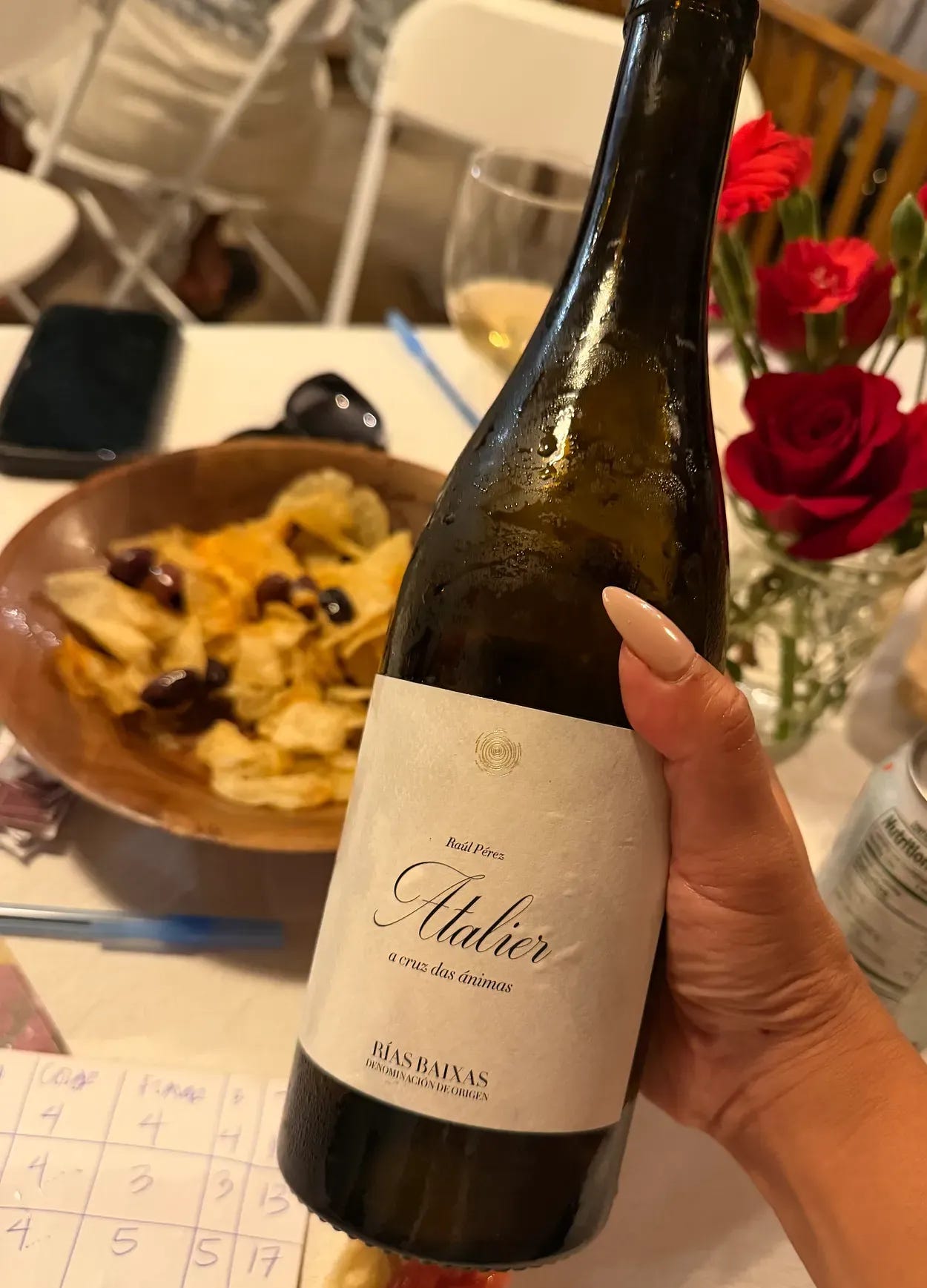
This wine was the winner of my wine tasting this past weekend, and the undisputed favorite of the night - but I will say, there was a tempranillo that I also loved. I give guests a list of regions to source from, everyone rates the wine throughout the night. The highest rated wine takes home my favorite bottle from the region. If you know me, you know I love healthy competition.
This wine stumped me, I could not for the life of me determine what the grape were. After further research, I found out is was an albariño by another name. Overall, it had all the features we know and love: minerality, texture, citrus, balanced acid - but there was something different about it. The finish was salty. It was a lot of fun in the glass and I would highly recommend it for a hot day - it was 90 degrees when we were tasting it. Give it a shot the next time you are shucking some oysters.